


Natural Polysaccharides Uptake in Intestinal Cells Relies on Clathrin/Dynamin1/Rab5-Dependent Endocytosis
Natural polysaccharides demonstrate diverse notable pharmacological activities including anti-tumor, immunomodulatory, antiviral, hypoglycemic, and anti-aging, with relatively low toxicity. Hence, natural polysaccharides are considered as promising source compounds for innovative drugs derived from traditional Chinese medicine (TCM). However, two key scientific questions remain unresolved for a long time. First, whether polysaccharides, which are the main active components of TCM decoctions, can be absorbed across the intestinal barrier and enter the bloodstream after oral administration? Second, which specific genes or key proteins regulate this process? The lack of clarity on these fronts has hindered the development of polysaccharide-based drugs and limited our understanding of the therapeutic mechanisms of the clinical effects of TCM.
Accumulating studies demonstrated that orally administered polysaccharides had been shown to produce significant pharmacological effects. Approximate 17 polysaccharide-based drugs are administered orally, encompassing both approved products or those in clinical trials according to the records in the Cortellis™ database. However, how these active polysaccharides reach the lesion sites after oral dosing remains unclear.
For decades, the large molecular weight and high hydrophilicity of polysaccharides were regarded as two major obstacles preventing them from crossing the intestinal barrier. Thus, the concept that polysaccharides cannot be absorbed by the intestine was widely accepted in the field. For instance, heparin shows minimal intestinal permeability and must be administered by injection. Nevertheless, some clinical studies suggested that high-molecular-weight chondroitin sulfate showed measurable oral absorption. Therefore, whether natural polysaccharides can be absorbed and enter the bloodstream after oral administration remains a major scientifical controversy in glycoscience field.
In a study published in Nature Communications, a team of researchers led by DING Kan at Shanghai Institute of Materia Medica (SIMM), Chinese Academy of Sciences, in collaboration with teams of WANG Kaiping from Huazhong University of Science and Technology, DIAO Xingxing and CHEN Hao from SIMM, reported that 1,3- and 1,4-linked polysaccharides uptake in intestinal cells relies on clathrin/dynamin1/Rab5-dependent endocytosis.
The study showed that polysaccharides with different linkages and charges could penetrate Caco-2 monolayer as intact macromolecules form. The permeability coefficients were larger than 1 × 10⁻⁶ cm/s, implying the in vivo absorption potential of these tested polysaccharides. In the in vivo pharmacokinetic test, the researchers found that the polysaccharides could be detected in plasma and liver tissues after oral administration and uncovered that intestinal uptake of polysaccharides mainly depended on clathrin/dynamin1/Rab5 dependent endocytosis.
Two model polysaccharides, branched β-1,3-linked glucan GFPBW1 derived from Grifola frondosa. and branched α-1,4-linked glucan WGE derived from Gastrodia elata Bl., respectively representing the major structure from fungi and medical plants, were employed to do further exploration. Importantly, the team combined three independent strategies: unlabeled (rat), isotope labeled (⁹⁹ᵐTc and ³H), and fluorescent labeled (Cy5.5 and FITC) to track the polysaccharides, the results showed that both polysaccharides could enter the bloodstream as original macromolecules with little degradation after oral administration in rats and mice. And the polysaccharides were distributed mainly to the liver, kidney, and gallbladder.
Further results demonstrated that the intestinal uptake of polysaccharides depended on endocytosis mediated by clathrin heavy chain (CLTC), dynamin1 (DNM1), and Rab5 via the comprehensive application of inhibitors, immunofluorescence staining, and gene knockdown analysis. Interestingly, polysaccharides mainly localized in early endosomes, the Golgi apparatus, the endoplasmic reticulum, and lysosomes upon internalization. Most importantly, the team also constructed several gene knockout mouse models including intestinal epithelial cell-specific clathrin knockout mice (CLTC CKO), Rab5 conventional knockout mice (RAB5A KO), and dynamin1 conventional knockout mice (DNM1 KO), and the uptake of polysaccharide in the intestines of CLTC CKO mice dropped sharply comparing with control mice (CLTCflox/flox). Furthermore, the intestinal absorption of polysaccharides was also markedly reduced in both RAB5A KO and DNM1 KO mice.
Moreover, the study further suggested that the uptake of polysaccharide with different structures might be regulated by some specific membrane receptors. The epidermal growth factor receptor (EGFR) was required for the uptake of both GFPBW1 and WGE. Bone morphogenetic protein receptor type IA (BMPRIA) regulated the uptake of WGE. The Dectin-1 regulated the uptake of GFPBW1. Further, the uptake process was influenced by Wnt/β-catenin and nuclear factor-κB (NF-κB) signaling pathways.
These findings challenged the traditional notion that natural polysaccharides cannot be absorbed orally. And the study not only provided molecular evidence elucidating the therapeutic mechanism of some orally administered polysaccharide drugs, but also offered pharmacokinetic validation for the clinically used polysaccharide medicines. Importantly, it also established a theoretical basis for developing new oral polysaccharide drugs. Building on these insights, regulating endocytosis pathways or targeting specific receptors may improve the oral bioavailability of polysaccharides. In the future such strategy may help convert more natural polysaccharides into convenient and effective oral medicines.
DOI: doi.org/10.1038/s41467-026-68542-w
Link: https://www.nature.com/articles/s41467-026-68542-w
Keywords: Polysaccharide absorption; Endocytosis; Intestinal epithelial cells
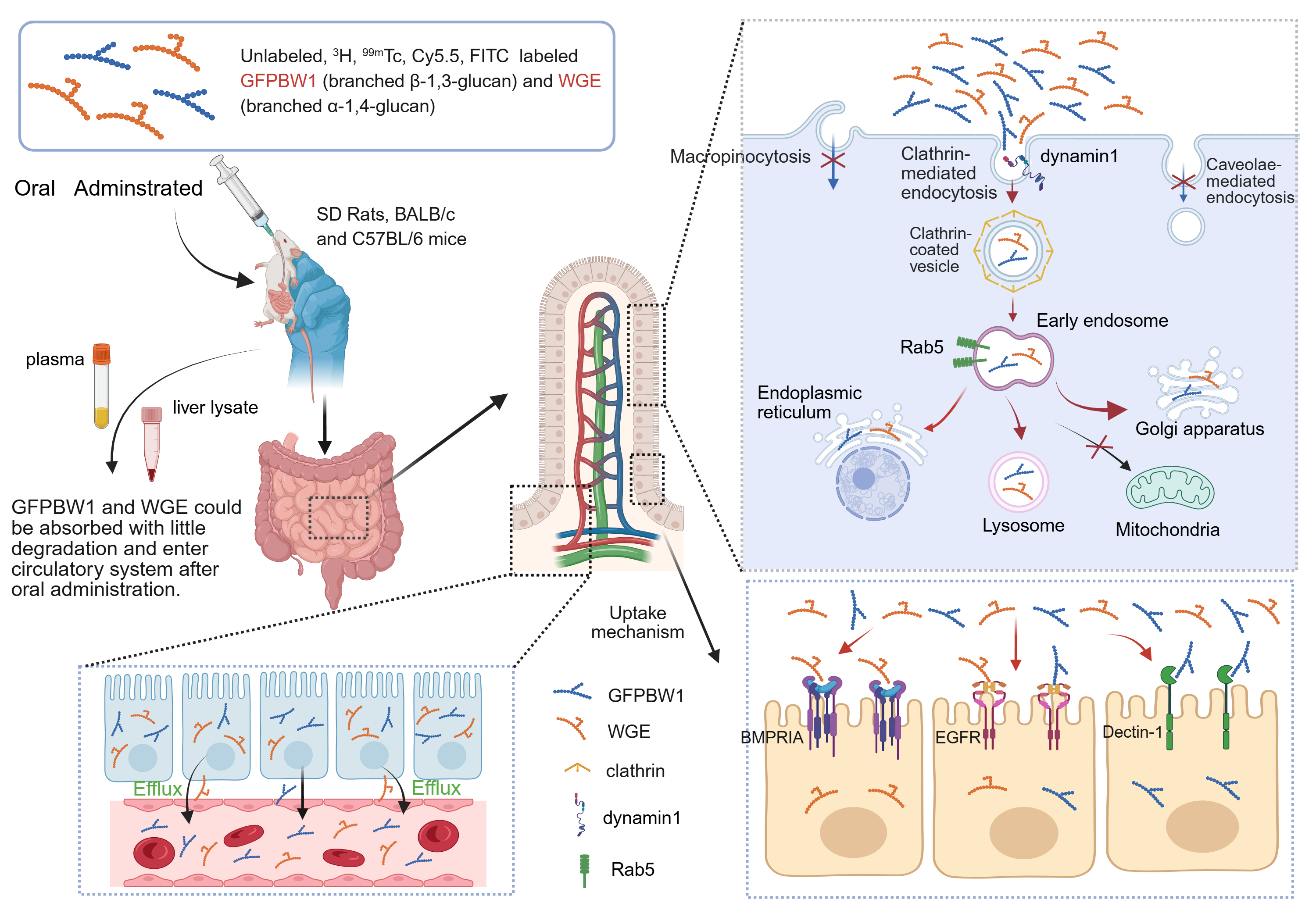
Oral absorption and transmembrane transport mechanisms of natural polysaccharides
(Image by DING Kan’s lab)
Contact:
DIAO Wentong
Shanghai Institute of Materia Medica
E-mail: diaowentong@simm.ac.cn