


Researchers Develop Novel Self-Amplifying RNA Vector NovaVec for Vaccine Development and Gene Therapy
Self-amplifying RNA (saRNA) vectors have emerged as a promising platform for vaccine development and gene therapy due to their ability to enhance transgene expression. This innovative approach mimics the replication mechanisms of positive-sense single-stranded RNA viruses, allowing for prolonged protein expression in host cells.
Recently, a collaborative research team from the Shanghai Institute of Materia Medica, Chinese Academy of Sciences, led by HAO Pei, along with the Molecular Plant Sciences Excellence Innovation Center, led by LI Xuan, and the Fujian Medical University, led by YAO Xiangping, published their findings in the international journal Vaccines. The research team established a Nodamura virus (NoV) autonomous replication system in Schizosaccharomyces pombe, allowing for direct monitoring of its replication function through a fluorescent reporter gene.
Using this system, the researchers identified two redundant mitochondrial targeting domains within the protein A sequence that are essential for RNA replication. Notably, the study demonstrated the compatibility of protein A with different organelles by successfully redirecting it to the endoplasmic reticulum (ER), restoring the full RNA genome replication capacity.
The findings of this research hold significant implications for the future of vaccine development and gene therapy. NovaVec, characterized by its compact genome size of only 3.2 kb and low cytotoxicity, offers a new technological platform that addresses the limitations of existing saRNA vectors, such as the Venezuelan equine encephalitis virus (VEEV). The ability of NovaVec to sustain long-term protein expression in vivo positions it as a potential candidate for next-generation nucleic acid vaccines.
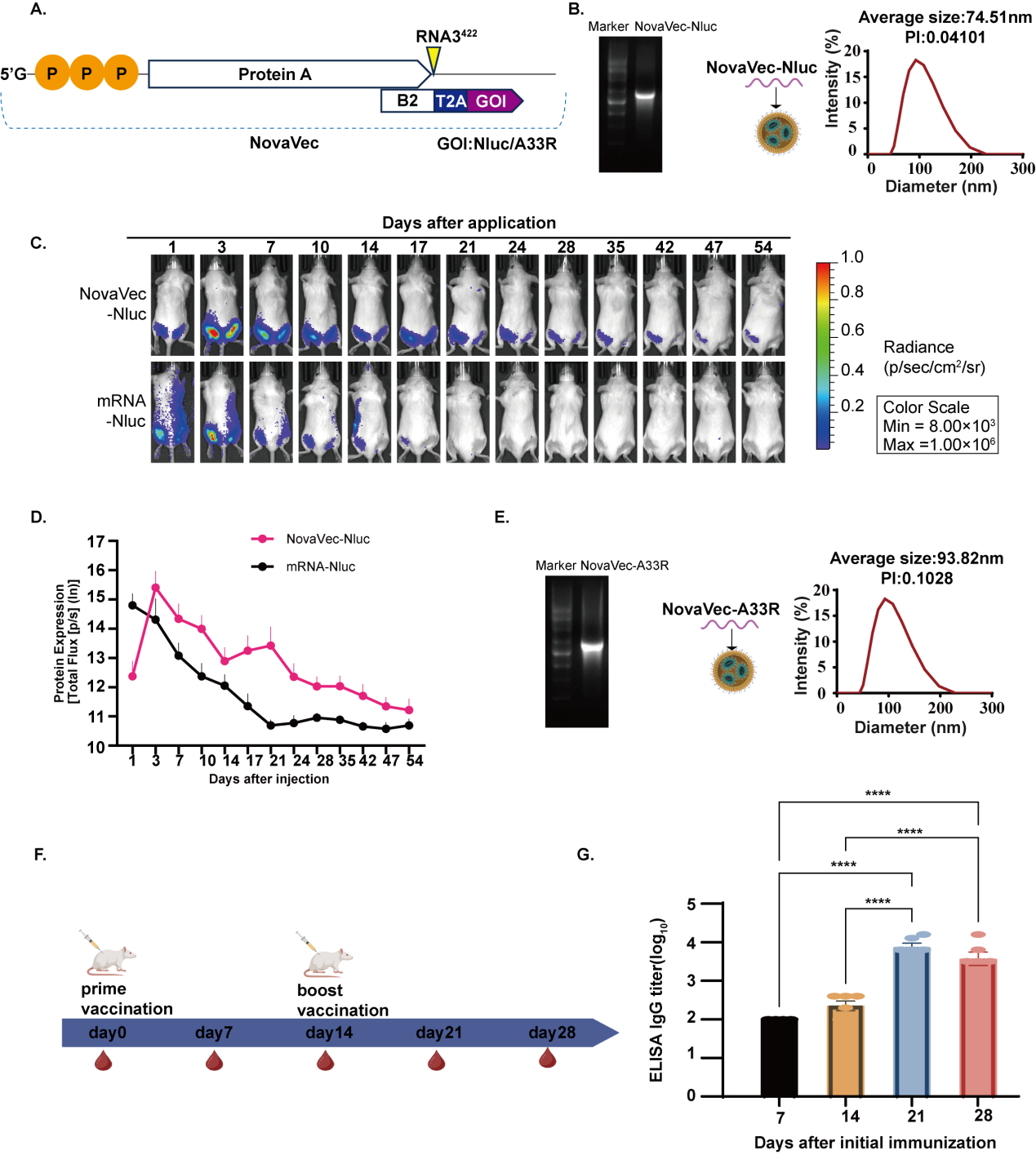
Figure: Design and In Vivo Efficacy Evaluation of the Self-Amplifying RNA Vector NovaVec. (A) Schematic diagram of NovaVec RNA structure; (B) Gel electrophoresis and characterization of LNP-encapsulated NovaVec-Nluc RNA; (C) Comparison of LNP-NovaVec's long-term expression in mice (54 days) versus mRNA vectors; (D, E, F, G) Characterization of LNP-NovaVec-A33R self-amplifying RNA vaccine and immune response experiments in mice (Image by HAO Pei’s Lab)
DOI: https://doi.org/ 10.3390/vaccines14060532
Link: https://www.mdpi.com/2076-393X/14/6/532.
Keywords: Self-amplifying RNA, Nodamura virus, Vaccine development
Contact:
DIAO Wentong
Shanghai Institute of Materia Medica
E-mail: diaowentong@simm.ac.cn