


Researchers Develop Plant Vesicle-DC Chimera to Reverse Mitochondrial Dysfunction in Cancer Immunotherapy
Tumors create a hostile environment that disables dendritic cells (DCs), the key activators of T-cell responses. Within tumors, hypoxia fragments DC mitochondria, triggers endoplasmic reticulum stress, and promotes lipid droplet accumulation, all of which compromise antigen presentation. Conventional DC vaccines often fail in the tumor microenvironment (TME) due to poor homing and high susceptibility to immune suppression. Therefore, there is an urgent need to develop a new strategy that can reverse DC mitochondrial dysfunction and enhance intratumoral DC infiltration and function.
In a study published in Nature Communications, a collaborative team led by LI Yaping from Shanghai Institute of Materia Medica, Chinese Academy of Sciences, WANG Dangge from Shanghai Jiao Tong University School of Medicine, and ZHAO Qi from University of Macau developed a plant-DC chimera to overcome these barriers.
The researchers engineered DCs to overexpress CCR2, enabling active tumor targeting via the CCL2-CCR2 axis. They then isolated algae-derived nanovesicles (ANVs) from Chlorella pyrenoidosa and loaded them into the engineered DCs. Under 670 nm light, ANVs performed photosynthesis, producing oxygen and NADPH to relieve hypoxia and oxidative stress. This inhibited HIF-1α-dependent Drp1 Ser616 phosphorylation, reversed pathological mitochondrial fission, and restored mitochondrial networks. Mitochondrial repair subsequently reduced ER stress and lipid accumulation while enhancing antigen presentation and T-cell priming. In humanized mouse models, the chimera outperformed conventional DC vaccines and synergized with anti-PD-L1 therapy to induce long-term immune memory.
“This work provides a cross-species chimera strategy for next-generation DC immunotherapy and demonstrates the potential of integrating photosynthetic components with immune cells,” said LI Yaping, corresponding author of the study. The findings offer a new direction for overcoming the immunosuppressive TME and improving cancer immunotherapy outcomes.
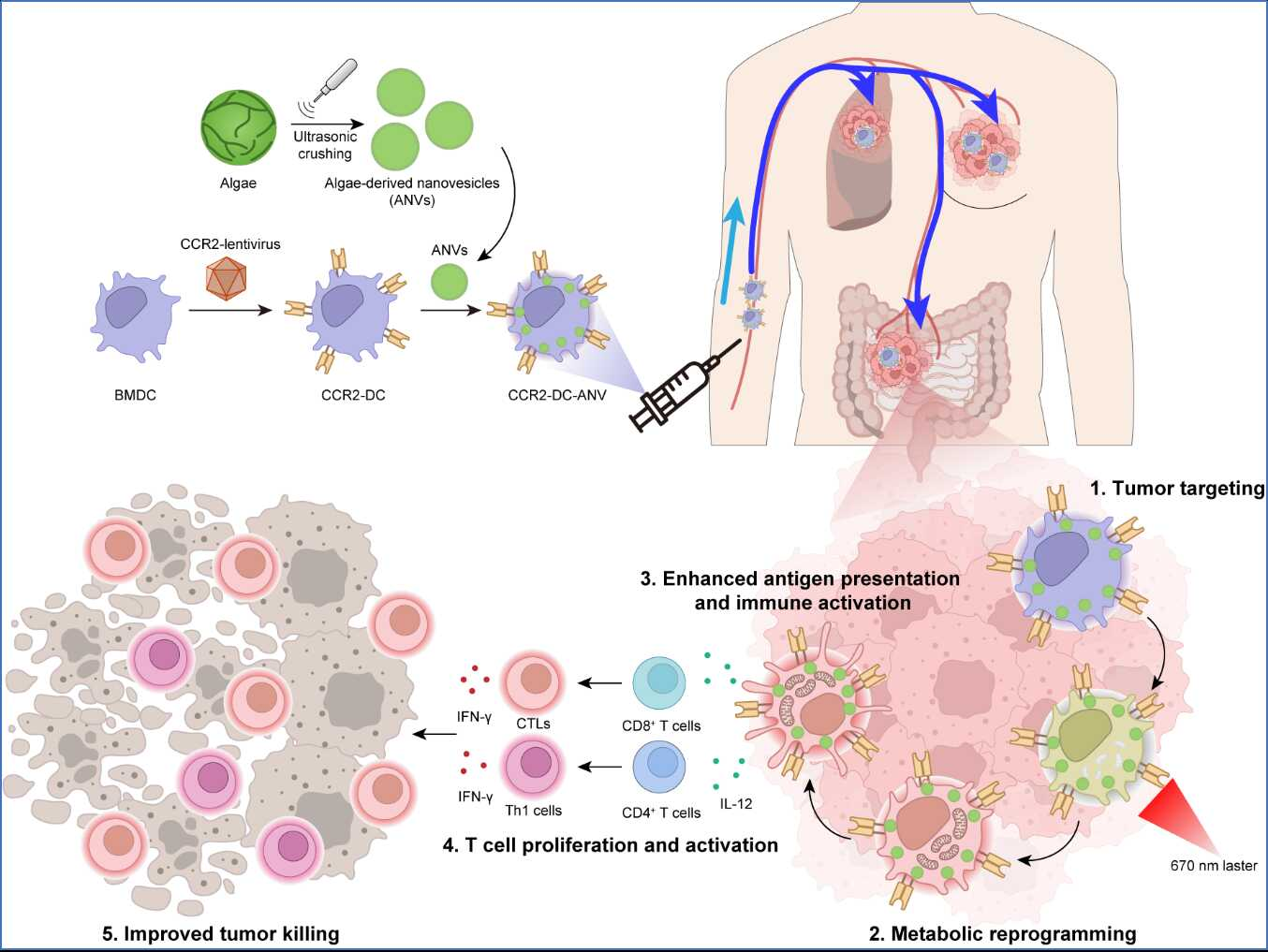
Schematic of the plant vesicle-DC chimera and its mechanism of action. (Image by LI Yaping Research Group)
DOI: 10.1038/s41467-026-73788-5
Link: https://doi.org/10.1038/s41467-026-73788-5
Keywords: dendritic cell therapy, mitochondrial dysfunction, algae-derived nanovesicles
Contact:
DIAO Wentong
Shanghai Institute of Materia Medica
E-mail: diaowentong@simm.ac.cn