


Researchers Reveal Structural Basis of Long-Range Transcription-Translation Coupling in Bacteria
Transcription and translation are the core processes of gene expression. In bacteria, these two processes occur in the same cellular compartment, occur at the same time, and in many cases, are functionally coordinated and physically coupled. This phenomenon is known as transcription-translation coupling. Previous work reported the molecular assemblies of tight transcription-translation complexes (TTC-B). Transcription elongation factor NusG or its paralog RfaH forms a bridge between RNA polymerase (RNAP) and ribosome, and the transcription elongation factor NusA optionally forms a second bridge between RNAP and ribosome. However, TTC-B accommodates only short mRNA spacer. When the ribosome has not yet caught up with RNAP, a long-range coupling mode also exists, but its structural mechanism remained elusive.
Recently, a collaborative team led by WANG Chengyuan from the Shanghai Institute of Materia Medica (SIMM), Chinese Academy of Sciences, and Richard H. Ebright from Rutgers University, published their findings in the Proceedings of the National Academy of Sciences (PNAS). The work defined a new structural state named long-range coupled complex (TTC-LC) for transcription-translation coupling.
Using cryo-electron microscopy (cryo-EM) reconstruction, the researchers resolved high-resolution structures of NusG/RfaH-mediated transcription-translation complexes with long mRNA spacers.Their results show that when the mRNA spacer exceeds 12 codons, RNAP undergoes a ~60° rotation and a ~70 Å translation relative to the ribosome. This rearrangement created a ~70 Å gap between the two molecular machines. Within this gap, the mRNA folds into a loop structure, effectively accommodating the extended spacer sequence.
Importantly, TTC-LC could shift into TTC-B after ribosomes caught up with RNAP. TTC-B also transformed back into TTC-LC when RNAP moved ahead of ribosomes. These observations establish TTC-LC is a functional intermediate in assembling and disassembling TTC-B, mediating pre-TTC-B transcription-translation coupling before a ribosome catches up to RNAP, and mediating post-TTC-B transcription-translation coupling after a ribosome stops moving and RNAP continues moving.
Further in vitro biochemical assays revealed distinct regulatory effects on transcription termination. TTC-B strongly blocked hairpin-dependent termination. TTC-LC produced only mild inhibition on this termination. Notably, both complexes efficiently suppress Rho-dependent termination. These findings shed new light on the regulatory roles of transcription-translation coupling in gene expression.
This study described the molecular basis of long-range transcription-translation coupling in bacteria for the first time. The dynamic switch between TTC-LC and TTC-B explained real-time gene expression regulation in bacteria. The two-state model filled gaps in earlier single-molecule experimental observations. The structural data offered new design ideas for synthetic transcription-translation systems. It also provided potential molecular targets for developing new antibacterial drugs.
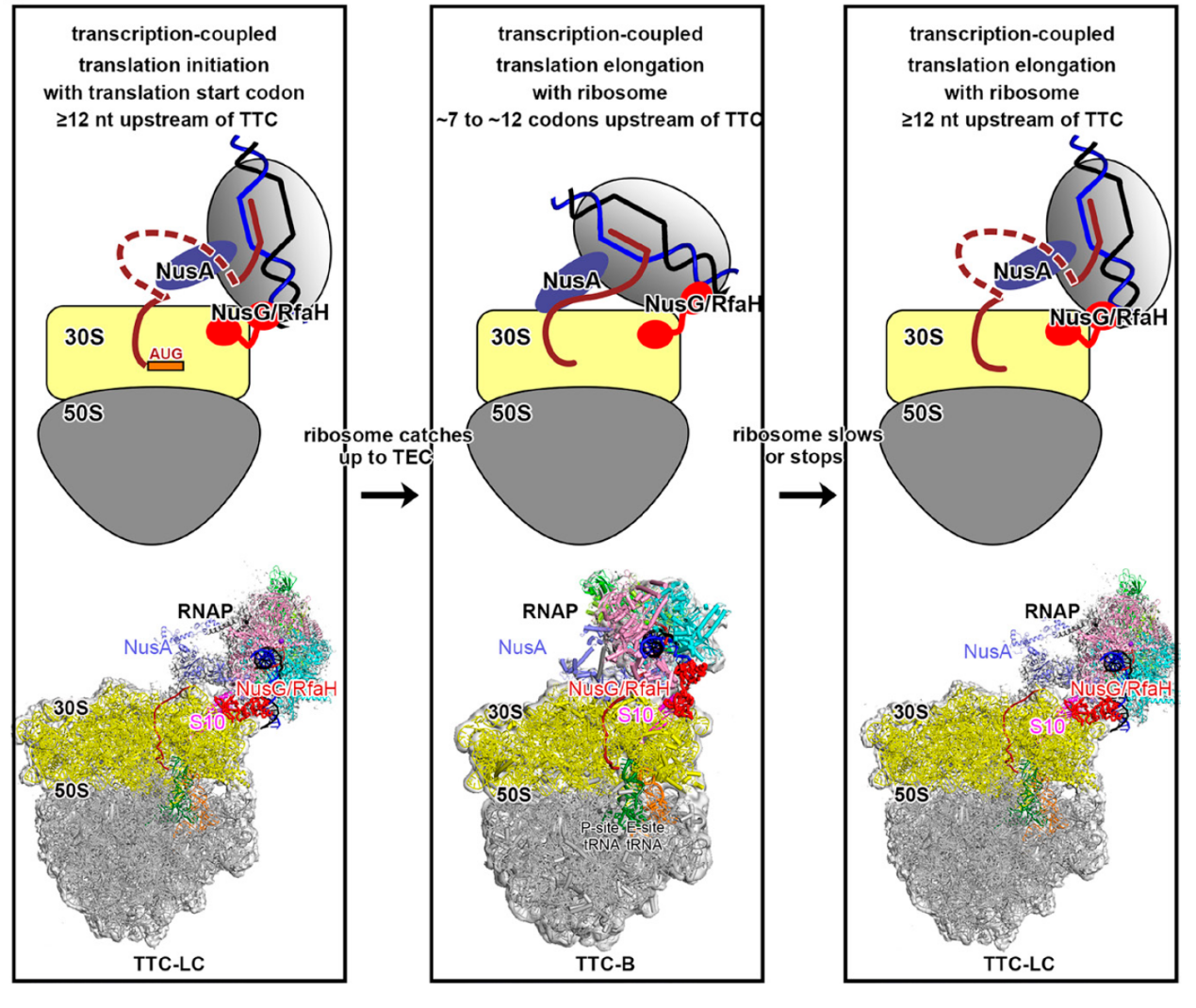
The structural model and dynamic conversion of TTC-LC
(Image by WANG Chengyuan’s lab)
DOI: https://doi.org/10.1073/pnas.2528970123
Link: https://www.pnas.org/doi/10.1073/pnas.2528970123
Keywords: RNA polymerase, ribosome, transcription-translation coupling
Contact:
DIAO Wentong
Shanghai Institute of Materia Medica
E-mail: diaowentong@simm.ac.cn