


Researchers Reveal How Three Allosteric Sites Cooperate to Amplify Dopamine Receptor Signaling
G protein-coupled receptors (GPCRs) transmit signals from outside cells to regulate a wide range of physiological processes. The dopamine D1 receptor (D1R) is a major GPCR in the central nervous system. It mainly couples to Gs/olf proteins and helps control movement, motivation, and cognition. Abnormal D1R signaling has been linked to Parkinson’s disease, schizophrenia, Alzheimer’s disease, and other neurological and psychiatric disorders. This makes D1R an important target for drug discovery. Most conventional D1R drugs act at the orthosteric pocket, where dopamine naturally binds. However, highly conserved binding pockets across dopamine receptor subtypes, limited bioavailability and brain penetration, and cardiovascular side effects have constrained their clinical use. Positive allosteric modulators (PAMs) bind at sites outside the orthosteric pocket and enhance the receptor’s response to dopamine. This approach may offer more selective and finely controlled ways to regulate D1R activity. Several D1R PAMs have advanced to clinical evaluation. Mevidalen (LY3154207), for example, was investigated for cognitive impairment in patients with dementia with Lewy bodies. However, D1R PAM candidates still face limitations in pharmacological activity and clinical efficacy. Previous pharmacological studies suggested that chemically distinct PAMs, including LY3154207, BMS-A1, and MLS6585, could exhibit cooperativity when co-administered. This raised the possibility that D1R contains multiple functionally connected allosteric sites. Yet only the binding site of LY3154207 had been structurally defined. Whether these spatially distinct sites could be engaged simultaneously, and how they jointly regulate receptor conformation and signaling, remained unclear.
In a study published in Science Advances, an international team of researchers led by ZHUANG Youwen from Shanghai Jiao Tong University School of Medicine, XU Huaqiang and WANG Yue from Shanghai Institute of Materia Medica (SIMM), Chinese Academy of Sciences (CAS), in collaboration with the teams of David R. Sibley and Lei Shi at the U.S. National Institutes of Health (NIH) and Kevin J. Frankowski at the University of North Carolina at Chapel Hill (UNC), together revealed that three distinct allosteric sites on D1R can be simultaneously occupied by different positive allosteric modulators (PAMs). Their combined action increased dopamine potency by more than 1,000-fold in a β-arrestin recruitment assay.
The team optimized the previously identified D1R modulator MLS6585 through medicinal chemistry, yielding two PAMs, UNC9815 and UNC10062, with improved activity and modulatory efficacy. Pharmacological assays showed that these compounds, LY3154207, and BMS-A1 enhanced dopamine- or SKF81297-induced D1R signaling to varying degrees. Combining LY3154207, BMS-A1, and UNC-series compounds produced cooperative or additive effects. TRUPATH bioluminescence resonance energy transfer (BRET) experiments further supported their cooperative enhancement of Gs protein activation. To investigate the structural basis, the researchers used cryo-electron microscopy (cryo-EM) to determine D1R–Gs complexes with different PAM combinations at resolutions of 2.4–2.6 Å. The structures revealed three nonoverlapping allosteric sites. LY3154207 bound near intracellular loop 2 (ICL2). BMS-A1 occupied a lower pocket at the interface between transmembrane helices 1 and 7 (TM1–TM7). UNC9815 and UNC10062 bound an upper pocket at the same interface. These vertically adjacent pockets formed an arrangement not previously characterized in GPCRs. Mutagenesis and functional assays confirmed their distinct roles. Certain upper-pocket mutations weakened UNC9815 potentiation or converted it into weak negative modulation. Comparisons across dopamine receptor subtypes also helped explain selectivity. For example, S36 at position 1.45 in D1R is replaced by bulkier W53 in D5R, creating a steric barrier to BMS-A1 binding. Molecular dynamics simulations suggested that D1R activation proceeds through stepwise stabilization. An orthosteric agonist initiated activation, while LY3154207 stabilized ICL2. BMS-A1 and the UNC compounds then reinforced intracellular and extracellular regions, respectively. These changes favored movement of transmembrane helix 6 (TM6), G protein engagement, and stabilization of transmembrane helix 7 (TM7) and extracellular loop 2 (ECL2). Together, they promoted a “super-stabilized active state.” The root-mean-square fluctuation (RMSF) of ECL2 decreased from 2.46 ± 0.77 Å without PAMs to 0.87 ± 0.11 Å with three PAMs. The simulations also suggested that extracellular pocket stabilization could restrict orthosteric agonist dissociation and contribute to increased dopamine potency.
This study extends the team's previous work from single-site regulation to cooperative multisite allostery. It shows how distinct PAMs stabilize complementary receptor regions, providing a framework for more selective D1R modulators and rational combinations. Further pharmacological and in vivo studies will be needed to assess therapeutic potential.
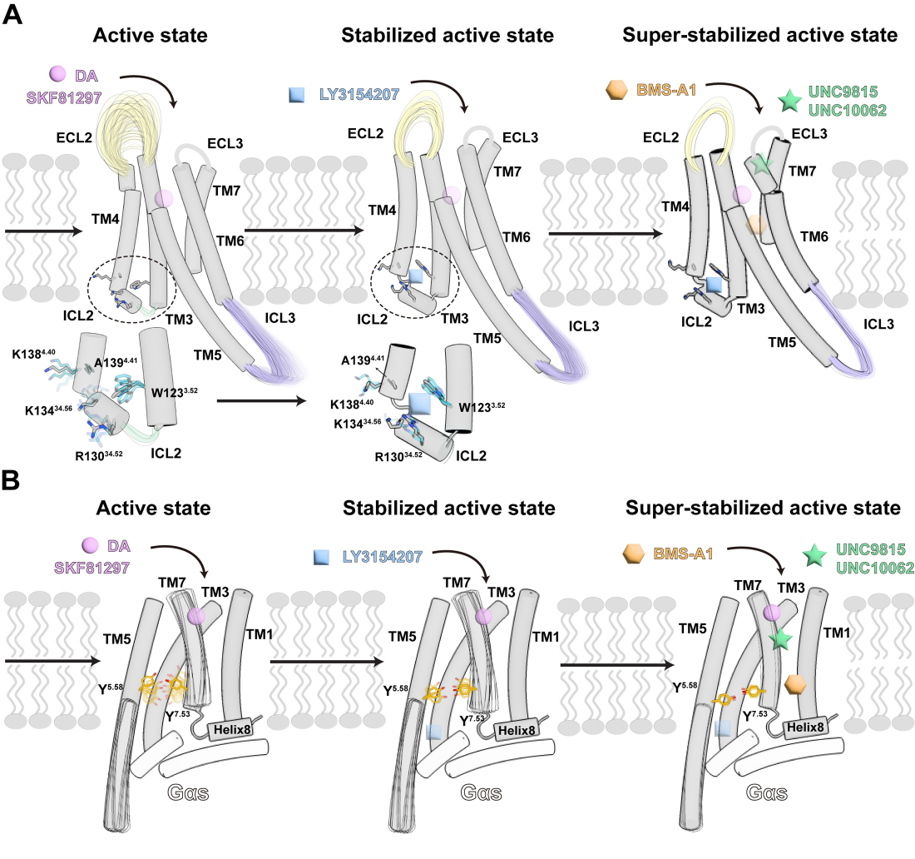
Proposed model of progressive D1R activation through cooperative allostery. An orthosteric agonist initiates receptor activation, while LY3154207, BMS-A1, and UNC-series PAMs stabilize distinct receptor regions. Their combined action promotes a highly stabilized active state that favors G protein coupling (Image by XU Huaqiang Research Group, SIMM)
DOI: 10.1126/sciadv.aeh3401
Article: https://www.science.org/doi/10.1126/sciadv.aeh3401
Keywords: Dopamine D1 receptor; positive allosteric modulators; cooperative multisite allostery
Contact:
DIAO Wentong
Shanghai Institute of Materia Medica
E-mail: diaowentong@simm.ac.cn