


Researchers Reveal How Cas5 Connects Calcium Balance and Virulence in Candida albicans
Calcium is an essential signal in fungal cells. It helps fungi respond to environmental changes, maintain cellular balance, and survive under stress. In the human fungal pathogen Candida albicans, calcium signaling also plays an important role in drug tolerance and infection. Calcineurin is a key protein that controls this signaling pathway. It activates the transcription factor Crz1, which regulates genes involved in calcium balance. However, calcineurin also controls fungal virulence through mechanisms that do not depend on Crz1. The molecular factors behind this process have remained unclear.
In a study published in Cell Chemical Biology, researchers from Shanghai Institute of Materia Medica, Chinese Academy of Sciences, and collaborating institutions identified Cas5 as an important regulator linking calcium balance and fungal virulence in C. albicans. The study was led by co-first authors WANG Yuanyuan, WU Yongqin, ZHANG Luyao, and LIU Jihong, YING Chunmei, ZHONG Lin, XUE Xinying, and CHEN Changbin served as co-corresponding authors.
The team first screened a large-scale gene deletion library of C. albicans under high-calcium conditions. They identified Cas5 as a previously unrecognized regulator of calcium balance. Further experiments showed that calcium stress increased Cas5 protein levels and promoted its movement into the nucleus. By combining transcriptome sequencing, chromatin immunoprecipitation sequencing (ChIP-seq), protein interaction assays, and genetic experiments, the researchers uncovered how Cas5 regulates the calcium response.
Cas5 directly bound to the promoter of TPK1 and repressed its expression. Tpk1 interacted with Crz1 and promoted its phosphorylation, limiting Crz1 nuclear localization and activity. By suppressing Tpk1, Cas5 facilitated Crz1 dephosphorylation and nuclear translocation, thereby promoting the expression of calcium-responsive genes. Deletion of TPK1 largely restored calcium tolerance and Crz1 activity in Cas5-deficient cells. These findings established a Cas5–Tpk1–Crz1 regulatory axis in calcium homeostasis.
The researchers then investigated whether Cas5 also contributed to fungal virulence. Transcriptome analysis revealed that Cas5 regulated genes associated with pathogenicity, cell adhesion, and biofilm formation. Loss of CAS5 reduced the expression of several virulence-associated genes, including ALS1, SOD1, PMT4, and SAP5. In contrast, deletion of CRZ1 did not produce comparable changes in virulence-related gene expression.
The team further tested these findings using human serum survival assays and a mouse model of systemic candidiasis. Both CAS5 and CNB1 deletion attenuated fungal virulence, whereas CRZ1 deletion did not cause a comparable reduction. Notably, overexpression of CAS5 partially restored serum survival and rescued the virulence defect of the cnb1Δ/Δ mutant in mice. Overexpression of CRZ1 did not produce the same effect. These results identified Cas5 as an important downstream effector of calcineurin-mediated virulence through a largely Crz1-independent pathway.
This study revealed two distinct regulatory functions of Cas5 in C. albicans. It controlled calcium homeostasis through the Tpk1–Crz1 axis and supported fungal virulence through a separate pathway. The findings expanded our understanding of how fungal pathogens coordinate environmental adaptation and pathogenicity. They also identified a fungus-specific regulatory factor that may provide a starting point for exploring new antifungal intervention strategies.
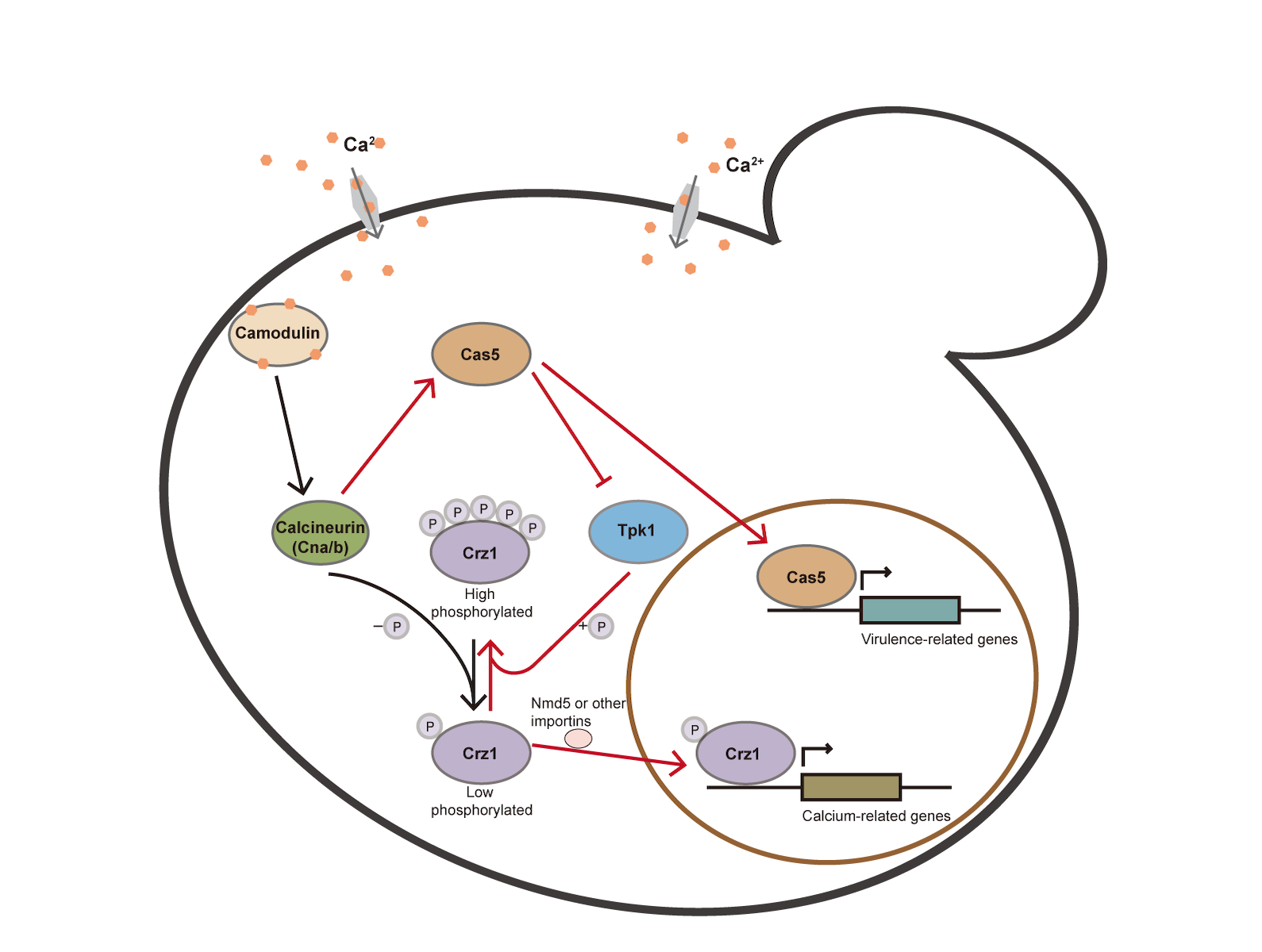
Figure. Cas5 coordinates calcium homeostasis and fungal virulence through two distinct regulatory pathways in Candida albicans (Image by CHEN Changbin Group)
DOI: 10.1016/j.chembiol.2026.10.001
Article link: https://doi.org/10.1016/j.chembiol.2026.10.001
Keywords: Candida albicans; Calcium signaling; Fungal virulence
Contact:
DIAO Wentong
Shanghai Institute of Materia Medica
E-mail: diaowentong@simm.ac.cn